How to choose
Which pan to buy first: cast iron, clad stainless or nonstick
Three skillet materials, three jobs. What each one is good at, what the nonstick coating really is, and the magnet test that settles induction.
A kitchen rarely needs the pan that is on offer. It needs the one that handles the thing you cook most often, in the quantity you cook it, on the hob you actually have. Everything else is a second purchase that can wait until the first pan has told you what is missing.
This guide compares the three skillet materials on what they physically do, states what the nonstick coating is according to the Food and Drug Administration rather than according to a brand page, and ends with the two checks that stop a pan arriving unusable. We have not tested cookware and there are no rankings here.
The three materials do three different things
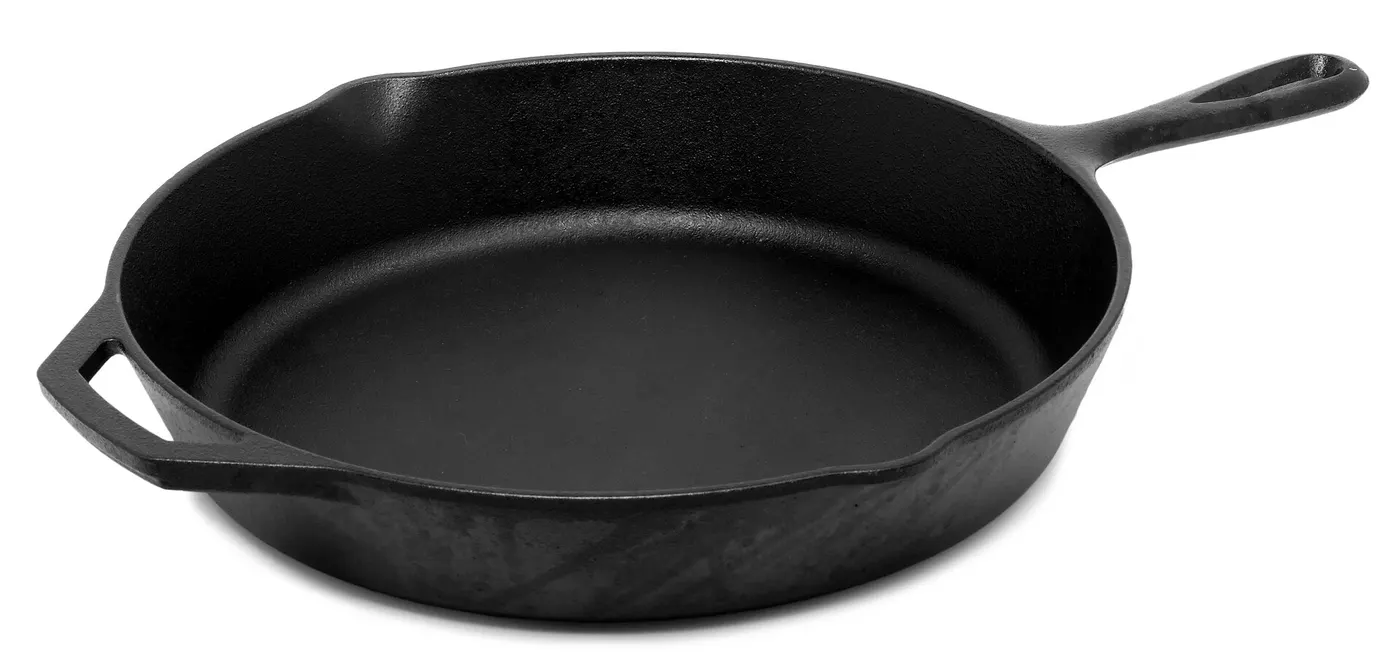
Bare cast iron stores heat. It takes several minutes to come up to temperature and then holds it when cold food hits the surface, which is why it sears and why it is heavy. It is not a non-stick surface in the manufactured sense; the slick layer is polymerised oil built up by use and by seasoning, and it has to be maintained rather than bought.
Clad stainless responds. A layer of aluminium or copper between stainless skins moves heat quickly, so the pan reacts to the dial in seconds and releases fond that makes a pan sauce. It is the material that handles acid, deglazing and long simmering without any surface to damage, and it is the one that sticks most readily if the pan is not preheated.
Nonstick releases. For eggs, pancakes, fish skin and anything delicate, a coated pan does what neither of the others does without technique. The trade is a service life measured in years rather than decades, which is the single fact that dominates the cost arithmetic in the costs guide on this site.
| Material | Strength | Weakness | The dish that justifies it |
|---|---|---|---|
| Bare cast iron | Heat storage, sear, oven to hob | Weight, needs seasoning maintained | Steak, cornbread, anything that starts on the hob and finishes in the oven |
| Clad stainless | Response, fond, handles acid | Sticks if under-preheated | Pan sauces, braises, tomato |
| Nonstick | Release without technique | Service life of a few years | Eggs, pancakes, delicate fish |
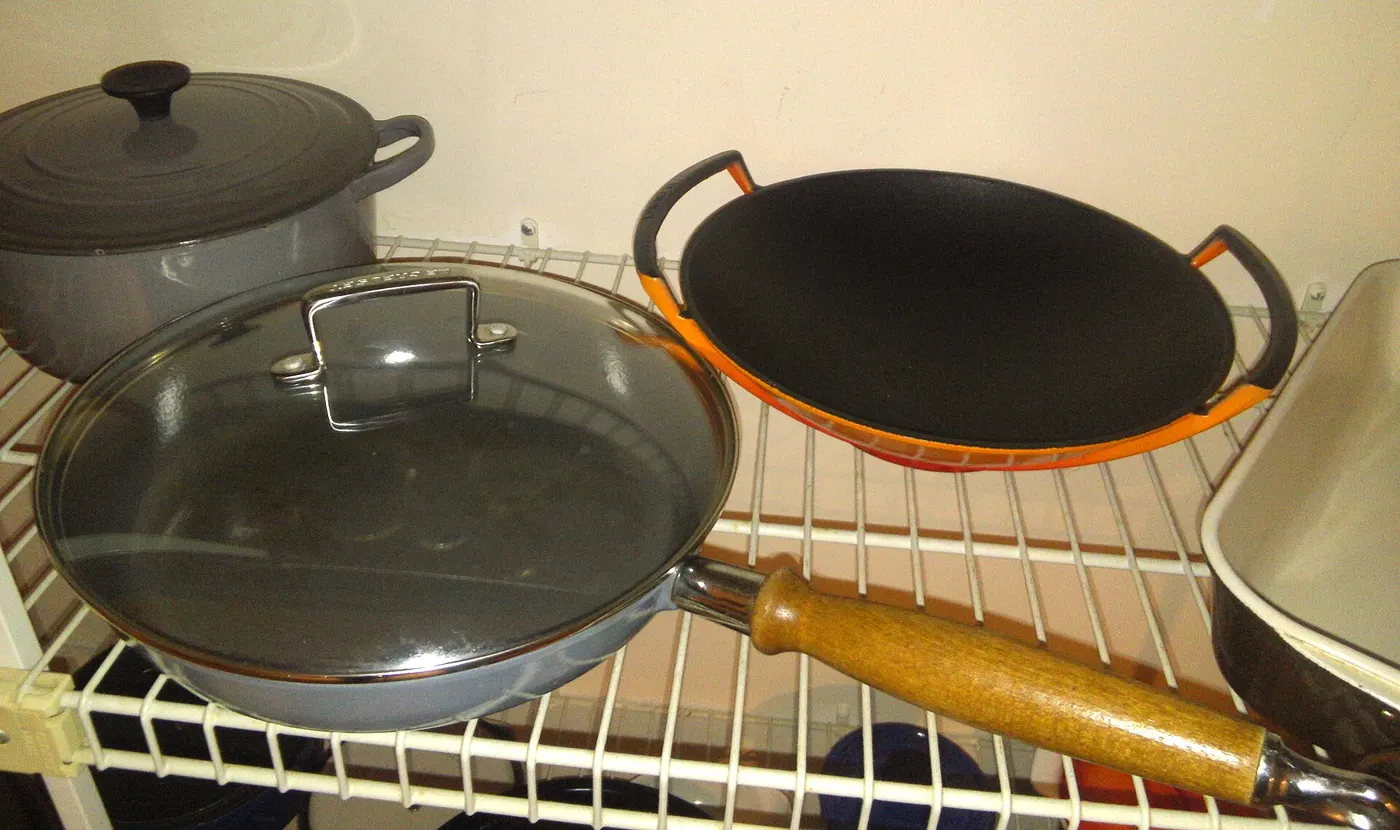
| Enamelled cast iron | Heat storage without seasoning, handles acid | Chips at the rim, heavy, costly | Braises and stews held for hours |
| Carbon steel | Lighter than cast iron, seasons like it | Warps if shocked with cold water | High-heat frying and stir frying |
Nothing in this table is a product recommendation. Each row names a physical property and the dish where that property is the deciding one.
What the nonstick coating actually is
The Food and Drug Administration lists four authorised categories for PFAS substances in food contact applications: nonstick coatings on cookware, sealing gaskets in food processing equipment, manufacturing aids, and grease-proofing agents on paper food packaging. The last of those was phased out of the US market, with the agency determining in January 2025 that the 35 food contact notifications covering grease-proofing agents on paper and paperboard were no longer effective.
On cookware itself the FDA's description is specific: the PFAS molecules are polymerised and applied at very high temperatures, which tightly binds the polymer coating to the pan, and the process vaporises off virtually all the smaller migratable molecules, so negligible amounts can migrate to food. That is the agency's own statement rather than a manufacturer's claim, and it is a different question from the one about paper packaging.
What this does mean for buying is that the coating is a consumable layer. It is bound to the metal, not part of it, and it wears. A pan whose coating has worn through has become a thin aluminium pan with a damaged surface, which is a reason to replace rather than a reason to panic, and the costs guide prices that replacement cycle out.
- Nonstick coating on cookware is one of four FDA-authorised PFAS food contact categories
- The grease-proofing agents used on paper food packaging were phased out, with 35 notifications ruled no longer effective in January 2025
- FDA states that negligible amounts of PFAS in a bound cookware coating can migrate to food
- The coating is a wear layer, so treat its life as a cost rather than a defect
- There is no ENERGY STAR category for cookware, so no efficiency label exists to compare pans on
Two checks that stop a pan arriving unusable
The first is induction. An induction hob needs a ferromagnetic base, and the test is a fridge magnet: if it grips the bottom of the pan firmly, the pan works. Cast iron and carbon steel always pass. Clad stainless passes only if the outer layer is magnetic stainless rather than the non-magnetic grade, and plain aluminium and copper fail unless a steel disc has been bonded to the base.
The second is the oven. A pan with a riveted metal handle and no plastic goes into the oven at any temperature the metal takes. A pan with a moulded handle has a stated maximum, and it is printed in the manual rather than on the shelf label. If your most frequent dish starts on the hob and finishes under a grill, that one number eliminates half the shortlist before any other consideration.
Diameter is worth measuring rather than assuming. Pans are usually sold by the rim diameter and the usable cooking surface is smaller, often by an inch or more on a sloped-side skillet. Four chicken thighs need a flat base wide enough that they do not touch, and a 10 inch pan with an 8 inch base will steam them instead of browning them.
| Check | How to do it | Where it is published |
|---|---|---|
| Induction compatible | Fridge magnet on the base | Manufacturer's specification page |
| Oven safe temperature | Read the handle material | Manual, not the shelf label |
| Usable base diameter | Measure the flat area, not the rim | Rarely published; measure in store |
| Weight when full | Add the pan weight to the food weight | Specification page |
| Dishwasher and metal utensil policy | Read the care sheet | Care documentation in the box |
Buy one pan, then wait
A seven-piece set is seven decisions made by someone who does not know what you cook. The alternative is to buy the one skillet that matches your most frequent dish, cook on it for two months, and let the gap announce itself. Households that do this almost always end up with three pans rather than seven, and all three get used.
Weight is the most under-weighted factor in that first decision. A 12 inch cast iron skillet full of food is heavy enough that some cooks will not lift it one-handed, and a pan that is not lifted is not used. If you are unsure, the 10 inch size is the one that handles two to three portions and is still manageable at the sink.
Price does not decide this. A $25 cast iron skillet used 4 times a week for 20 years works out at about 0.6 cents a use, and the costs guide on this site shows why the cheapest pan to buy can be the most expensive to own once the replacement cycle is counted.
Before you buy
- Write down the dish you cook most often and the number of portions
- Pick the material whose physical property that dish needs, before looking at any brand
- Hold a magnet to the base if you cook on induction
- Read the oven-safe temperature in the manual if the pan finishes under a grill
- Measure the usable flat base, not the rim diameter
- Lift an equivalent weight at the sink before committing to a 12 inch cast iron pan
- Buy one pan and wait two months before buying the second
Questions readers ask
- Is cast iron worth the weight?
- It is when you sear, bake or move the pan to the oven, because heat storage is the property doing the work. It is not when the pan has to be lifted one-handed at a sink several times a day. A 10 inch pan is the compromise most kitchens settle on, and carbon steel does much of the same job at lower weight.
- Should I worry about PFAS in a nonstick pan?
- The FDA's position on cookware is that the coating is polymerised and bound at high temperature and that negligible amounts can migrate to food. The agency's separate action concerned grease-proofing agents on paper packaging, which were phased out of the US market. Treat a worn-through coating as a replacement trigger rather than a hazard assessment.
- How do I know a pan will work on induction?
- Hold a fridge magnet against the base. A firm grip means the base is ferromagnetic and the hob will drive it. Cast iron and carbon steel always pass. Clad stainless depends on which grade is on the outside, and aluminium or copper only pass if a steel disc is bonded on.
- Is an expensive pan better?
- On a measurable property, sometimes: thicker cladding spreads heat more evenly and a heavier base holds it longer. On service life, price predicts very little for coated pans, because the coating wears on a timetable set by heat and utensils rather than by price. Buy the property you need and ignore the tier.
- Why is there no efficiency rating on cookware?
- Because ENERGY STAR has no cookware category. It certifies dishwashers, refrigerators, clothes washers and electric cooking products, which are appliances rather than pans. Any energy comparison between pans therefore has to be worked out from mass and heating time, which the costs guide on this site does.
Sources
- U.S. Food and Drug Administration — Authorized Uses of PFAS in Food Contact Applications — checked 2026-11-03
- ENERGY STAR — certified product categories (confirms there is no cookware category) — checked 2026-11-03
- Lodge Cast Iron — How to Season (manufacturer's own care documentation) — checked 2026-11-03
Some links on this site can earn us a commission. That does not change which product a guide recommends, and it adds nothing to your price. Advertising is not enabled on this site yet. When it is, ads will be labelled and kept visually separate from the guides.